
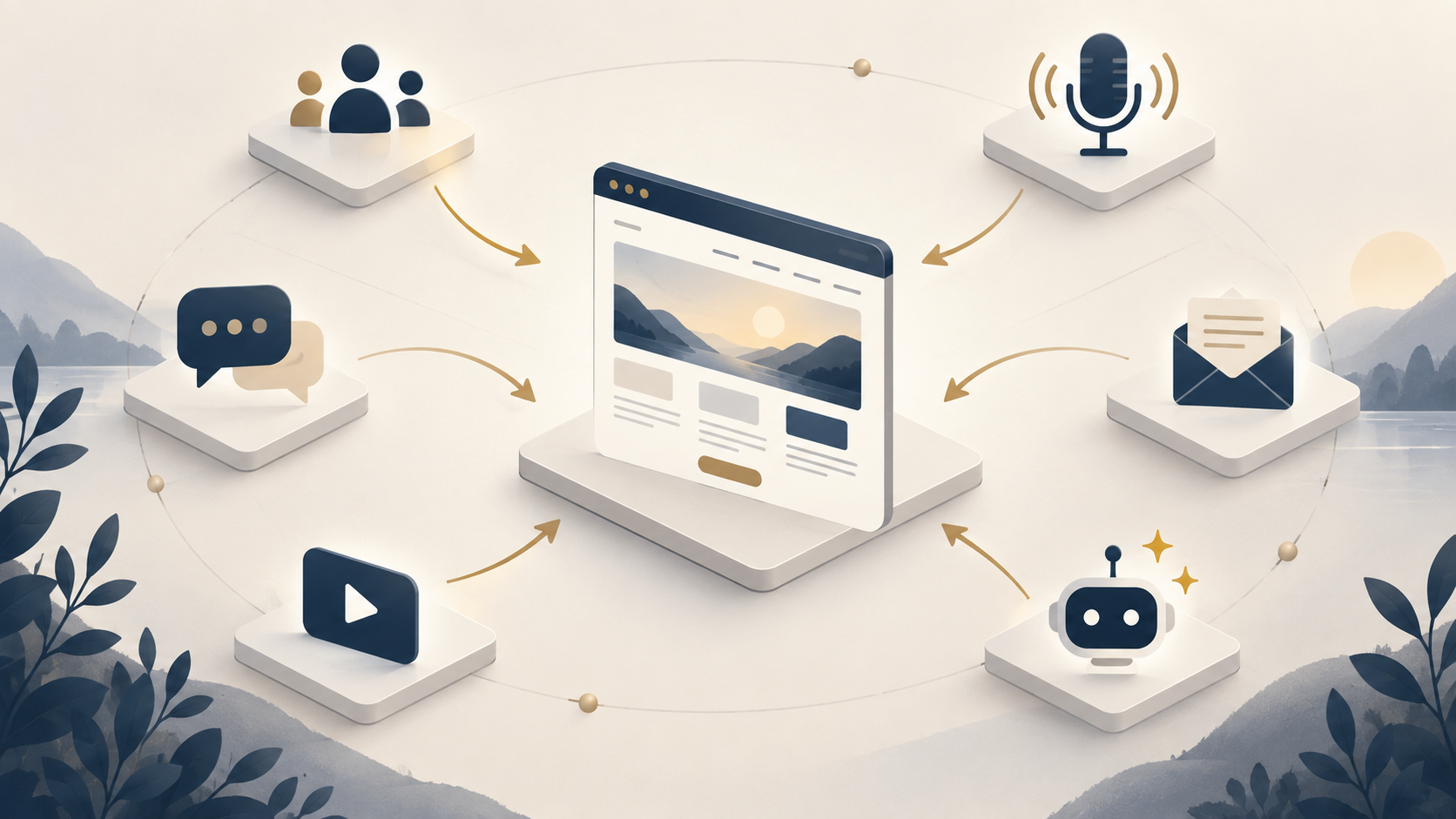
A personal brand usually does not live in one place. Over the past decade, service professionals have built visibility on LinkedIn, WeChat, Instagram, YouTube, TikTok, newsletters, podcasts, AI assistants and a growing stack of niche platforms. Each one reaches a particular audience at a particular moment.
A website is still the only channel you fully own and control. That is why it remains the basic of your personal branding online — not because it is the loudest channel, but because it is the place where everything else can point back.
This article keeps the original argument from the 2018 version and updates it for a more crowded, AI-mediated digital landscape.
What “basic” actually means here
In building work, a basic is the minimum structure that has to be in place before anything else can stand on it. For personal branding, the basic is the place that:
- is yours, not rented from a platform
- explains who you help and how you think, in your own voice
- collects the work you have already done, so it does not vanish when an algorithm changes
- gives a serious prospect somewhere to land before they decide whether to trust you
Without that basic, every channel becomes a stall. Each post, video or introduction creates a small moment of interest, and then the prospect has nowhere to go that you fully control.
A website is the only channel you fully own
A website is the only digital channel where the platform, the address, the design, the content, the analytics and the audience data can all be under your control. Even a no-code builder gives you more ownership than a social profile, and a custom site gives you the most.
Social platforms change their reach, their formats and their policies on a regular cadence. Search engines update how they rank and summarise content. AI assistants and answer engines now sit between many prospects and the source they actually read.
When your brand only lives inside other people’s platforms, every change in those platforms changes your business. A website is the one place whose rules you can choose. That is not a small thing. It is the difference between renting your reputation and owning it.
A website is where judgment becomes legible
Personal branding is rarely decided by reach alone. Prospects are also asking whether your judgment, your values and your way of working are credible and relevant to them.
That kind of trust does not fit inside a 280-character post, a short video or a single profile page. It needs space to show:
- the situations you have actually worked on
- how you explain a trade-off
- what evidence you are willing to stand behind
- who you are not the right fit for
A website gives you room to make that judgment legible in your own voice, and to revise it deliberately over time. Other channels can preview it; only a website can hold the full version.
A website gives you control over context
Other channels control the context around your content. The algorithm decides what appears next to your post. The platform decides which calls to action are allowed. The format decides how much nuance you can express.
On your own website you control:
- the journey a visitor follows
- what evidence appears beside each claim
- how your services, qualifications and case material are framed
- the next step you want a serious reader to take
That control is not about polish. It is about making sure a considered reader sees your work in the context you intend, not the context a platform or an AI summary has chosen for them.
A website makes everything else work harder
Most service professionals today are not choosing between a website and social media. They are running both. The question is whether those channels are isolated or connected.
When a website is the basic of your personal branding, every other channel has a destination:
- LinkedIn articles and posts point to longer explanations on your site
- WeChat Moments and articles link to a permanent home for your work
- YouTube descriptions and video cards send viewers to a written version
- Podcast show notes reference a deeper article
- AI assistants and search summaries can cite a stable, structured source
Without that destination, each channel has to do the full trust-building job on its own. With it, each channel becomes an entry point to one shared foundation.
A website is more retrievable than a feed
A social feed is optimised for the next post, not the one you published three years ago. Search engines and AI assistants, on the other hand, can usually surface a relevant page from your own website years after it was written, especially when the topic, audience and structure are clear.
For service professionals, this matters more than it looks. The prospect who finds your 2021 article on a specific client situation, or your 2023 explanation of a regulatory change, may be the most useful prospect you meet all year. A website gives those older pieces of work a real chance of being found.
When a website is not yet the right basic
A website is the basic of personal branding, but it is not always the right next step. If you are still validating who you help and what you offer, a small landing page or a single LinkedIn profile may be enough for a season. The point is not to build a website first no matter what. The point is to make sure the foundation you build is one you own.
Once that audience and offering start to firm up, a simple, well-written personal branding website becomes the place where all of the above actually compounds.
What a service professional’s website should do
For service professionals whose work depends on trust, a useful website usually does five things:
- names the people and situations the work is for
- explains how the professional thinks, not only what they sell
- shows the evidence behind the claim, in proportion to the stakes
- describes what working together feels like in practice
- offers one clear next step for a serious reader
A website that does those five jobs will quietly outperform a more polished site that does not. It is also the basic on which everything else in your personal brand can stand.
A practical starting point
If you do not yet have a personal website, the lightest reasonable starting point is usually a small site with:
- an About page that makes relevance and judgment legible
- a Services or Who I Help page that defines the fit
- one or two written pieces that show how you actually think
- a clear, proportionate way to contact you or book a conversation
Agent Infinite’s Who We Help page describes the kinds of professionals this kind of basic is designed for, and the About page describes the kind of work we take on so the basic can stay focused on the professional’s own voice.
If you already have a website, the more useful question is whether it is doing the five jobs above. Most personal websites are not. Refreshing one or two pages is often a higher-leverage move than adding another channel.
Keeping the basic in proportion
The point of a website being the basic is not that it should become the centre of your working life. The point is that it should be quiet, durable and yours, so that the channels where you spend your energy have somewhere solid to send people.
In an attention economy that is increasingly shaped by platforms and AI assistants, owning one small, well-kept corner of the internet is one of the simplest and most durable advantages a service professional can build.


Comments
Join the discussion.
Be the first to comment.